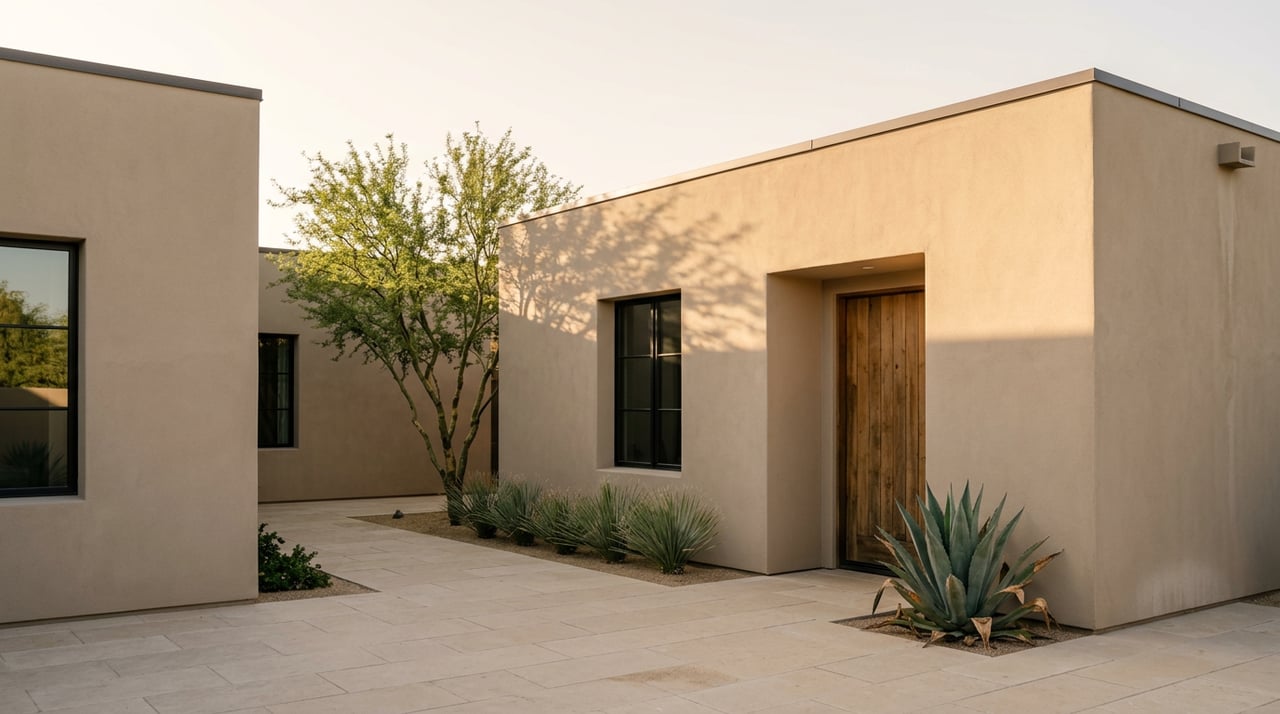
Since Arizona's new accessory dwelling unit law took effect, calls to Tucson contractors and design-build firms have followed the same script. A homeowner in Catalina Foothills reads that the state now guarantees the right to build a casita, calls a builder to talk finishes and square footage, and starts pricing out a detached guest house behind the pool. The conversation usually stalls at the same question. Which HOA are you in.
That question decides more about the project than the county's zoning code does. Most of Catalina Foothills sits in unincorporated Pima County, governed not by the City of Tucson but by neighborhood associations with their own recorded covenants and design review committees. The state law that generated all the enthusiasm settles only one of the two approvals a Foothills homeowner actually needs. It fixes what the county has to allow. It has almost nothing to say about what a specific association will approve.
Two laws, one deadline
Arizona built its ADU framework in two pieces. House Bill 2720 in 2024 forced cities over 75,000 residents to permit accessory dwelling units on single-family lots and stripped out owner-occupancy requirements. That covered Tucson proper but left unincorporated county land, where Catalina Foothills sits, untouched.
House Bill 2928, signed May 23, 2025, closed that gap by extending nearly identical standards to counties statewide. The bill set a hard deadline: counties had until January 1, 2026 to adopt compliant regulations. Miss it, and a default provision kicks in that requires ADUs to be allowed on every residential lot with no county zoning limits at all. Pima County now has its own standards in place under this requirement.
What the county actually allows now
Pima County's adopted rules give unincorporated Foothills parcels a fairly generous floor:
- One attached and one detached accessory dwelling unit per residential lot
- A 5-foot side and rear setback requirement
- A minimum separation of 3 to 10 feet between the ADU and the main house, depending on lot size
- A guest house provision available on parcels of at least 4,000 square feet
- Shared utility connections and driveway with the primary residence
- A third unit allowed only on parcels of one acre or more, and only if it's deed-restricted as affordable housing
- Kitchens permitted, and long-term rental use allowed outright
For most Catalina Foothills estate lots, the size floor is not the obstacle. Foothills parcels routinely run well past that 4,000-square-foot minimum. On paper, the county has made this close to a formality for anyone on a standard Foothills lot.
Where the county's authority stops
The county's yes is not the last word. Autonomous.ai explains that existing HOA covenants remain fully enforceable under the new law, and the statute only prevents a city or county from forcing a homeowner to accept a new restrictive covenant as a condition of the ADU permit itself. It does nothing to unwind the covenants already recorded against a property. As the Mulcahy Law Firm explains, ordinances that allow ADUs do not supersede HOA rules that prohibit or restrict them.
In Catalina Foothills, that matters because of how governance is actually structured. The Catalina Foothills Association oversees the neighborhood's original Areas 1 through 9, but it only administers CC&Rs and Design Guidelines directly for Areas 1 through 6. Areas 7 through 9 answer to their own individual associations, each with its own recorded declaration and its own Architectural Review Committee. Catalina Foothills Estates No. 9, for example, operates under a declaration recorded in December 2006 and, as Catalina Foothills Estates No. 9 notes, its resale disclosures are required under Arizona's HOA resale statute.
The practical result is a stack, not a single gate:
| Layer | Authority | What it controls |
|---|---|---|
| State law (HB 2928) | Arizona Legislature | Minimum floor: the county must permit at least one attached and one detached ADU on a qualifying lot |
| County ordinance | Pima County | Baseline standards: setbacks, lot-size minimums, size caps, the one-acre affordability rule for a third unit |
| HOA covenants | Your specific association | Whether the design gets approved, whether the casita can be rented, and how long the review takes |
Clearing the first two layers tells a homeowner almost nothing about the third. The association is where the actual decision happens.
The income-casita catch
Buyers eyeing a Foothills property with an eye toward a casita as rental income run into the same layering problem from a different angle. County rules permit long-term rental use of an ADU outright. That says nothing about what a given gated community will tolerate. Across Foothills associations, short-term rental policy varies by community. Communities like Pima Canyon, Ventana Canyon, La Paloma, Skyline, and Dakota Hills each set their own terms through their own governing documents, and a rule that applies in one gated enclave may not exist at all in the next one over.
A buyer comparing two Foothills listings on the assumption that "casita income potential" means the same thing in both is comparing the wrong variable. The county rule is fixed. The association rule is the one that actually determines what a casita is worth to that specific owner.
What this changes before you draw plans
The order of operations that makes sense here runs backward from what most homeowners assume. Before an architect gets a call, the recorded CC&Rs and Design Guidelines for the specific area need to come out, along with a clear answer on which Architectural Review Committee has jurisdiction over that parcel, the Catalina Foothills Association for Areas 1 through 6 or an individual association's own board for the rest. Rental language in those same documents needs a second read, since it governs the casita's use long after construction wraps.
This is the kind of layered review a construction and design background is built for. Reading a set of Design Guidelines the same way you'd read a set of architectural plans, and knowing in advance which committee's approval actually matters for a given lot, changes a six-month guessing exercise into a two-week confirmation. For a seller weighing a pre-listing casita addition to widen the buyer pool, or a buyer trying to price in future rental income, that distinction is worth more than the state law headline ever was.
A few questions worth asking before you commit
Does Arizona's new ADU law override my HOA's rules in Catalina Foothills? No. The law prevents a city or county from requiring a new restrictive covenant as a condition of an ADU permit, but it does not touch covenants your association already has recorded. Those remain fully enforceable.
How big can a casita actually be on a Foothills lot? Under Pima County's adopted standards, a detached guest house is available on parcels of at least 4,000 square feet, with a 5-foot setback and 3 to 10 feet of separation from the main house depending on lot size. A third unit is only available on parcels of one acre or more, and only if deed-restricted as affordable housing.
Can I rent my casita out short-term? The county allows long-term rental use of an ADU outright. Short-term rental policy is set association by association. Check your specific HOA's rules before assuming either way.
If you're weighing a casita addition ahead of a listing, or trying to figure out what a guest house actually adds to a Foothills property you're considering, Marta Harvey can walk through the specific HOA documents governing your address before you spend a dollar on plans. Get My Valuation and we'll start there.
This article is general information, not legal, tax or financial advice. Consult a qualified professional about your situation.